You open your laptop with a task that demands your full attention and, ten minutes later, you’ve answered two messages, overheard someone else’s video call and lost your train of thought. It’s not a lack of discipline: your environment has more influence over how well you can focus than most of us think.
Deep work is the ability to work without distractions on a demanding task. But not everyone achieves it in the same place: some people need absolute silence, others work better with a bit of background buzz, and others move between spaces depending on the task.
At betahaus Barcelona, in the heart of Gràcia, we have different spaces so you can choose the one that fits the way you work. Let us introduce them one by one.
What deep work is and why your environment matters
The term deep work was popularised by author Cal Newport to describe the kind of work you do with your mind pushed to its limits, free from distraction: writing, programming, analysing, designing, studying. It’s the opposite of shallow work, such as answering emails, coordinating or checking notifications, which is necessary but doesn’t demand the same level of concentration. If you want to go deeper into the concept, read our article Deepwork: what it is, how to get it.
Getting into that state takes two things. The first is up to you: protected blocks of time, notifications off and a clear task. The second is the place. A nearby conversation, a screen moving in your field of vision or someone constantly walking past your desk is enough to break your concentration, even if nobody is talking to you.
That’s why there’s no single ideal space. What feels calming to one person is boring to another, and the same person needs different things throughout the day: silence to write in the morning, a bit of atmosphere for lighter tasks in the afternoon, a break outdoors in between. Working in a coworking space with several kinds of space lets you adjust your environment to the task.
The spaces at betahaus for focusing
betahaus is a six-floor building with more than 2,000 m², and each area has its own rhythm. These are the spaces designed for working with your mind on one thing only, plus the booths so that calls don’t disturb anyone.
The 20 phone booths, for your calls
These are soundproofed booths for one person, and we have 20 of them. They are for calls and video calls only. That way conversations stay inside the booth and the quiet zones stay quiet for those who are concentrating.
Quiet flex zones
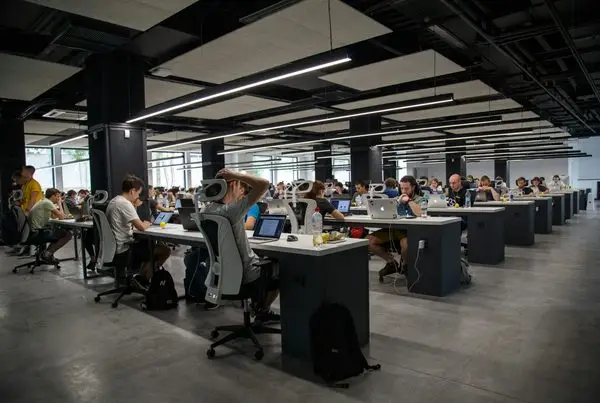
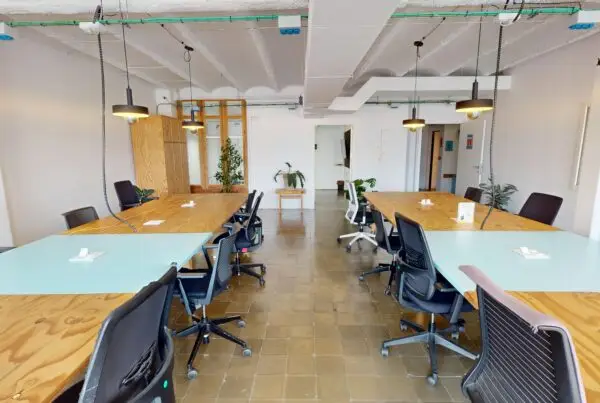
Shared desks where silence is the norm. You pick a free seat each day, sit down and work without conversations around you. They suit anyone who needs calm to write, code or analyse but prefers not to have a fixed desk.
Flex talking zones
Here you can talk. There’s more movement, work conversations and a bit of atmosphere. It’s the space for collaborative or lighter tasks, and for those who work better with background buzz than in total silence.
Quiet dedicated desk zones
Your own desk, reserved for you every day in a quiet zone. Your desk, your routine and the same environment every morning. It’s the option for people who do deep work daily and want to arrive and start without thinking about where to sit.

At a glance
| Space | Atmosphere | Ideal for |
|---|---|---|
| Phone booths (20) | Soundproofed, for one person | Calls and video calls |
| Quiet flex | Shared silence, free seat | Writing, coding or analysing without a fixed desk |
| Flex talking | Conversation and atmosphere | Collaborative work and lighter tasks |
| Quiet dedicated desk | Silence, your own desk | Daily concentration and routine |
Common areas: where you can talk and switch off
Deep work isn’t continuous. The best focus sessions alternate with real breaks, and we have spaces for that too.
The dining room, the patio and the four terraces are areas where you can work and talk freely. They’re the place for an informal meeting, for lunch with other members, for a call that doesn’t need a booth or simply for a change of scenery after hours in front of a screen. The terraces, with natural light and fresh air, are the best place to switch off between two blocks of work. And if you need to clear your head completely, there’s a ping pong table.
The idea is that you never have to leave the building to change pace: you focus in a quiet zone, get up, have a coffee or some fresh air and come back with a clear head.
How to choose your space depending on how you work
There’s no single answer, but these guidelines can help you decide:
- You need maximum silence. The quiet zones, flex or dedicated, are your place. The booths are for calls.
- You want quiet, but no strings attached. The quiet flex zone gives you a free seat in a calm environment, and you choose it each day.
- You work better with some atmosphere. The flex talking zone lets you talk and work with movement around you.
- You do deep work every day. A dedicated desk in a quiet zone gives you a routine and a place of your own.
- You combine tasks. Split your day: quiet zone in the morning, dining room or terrace for lunch and informal meetings, booth for calls.
If you’re not sure which one is yours, the easiest thing is to try them. With a Day Pass you can spend a whole day at betahaus and see which zone works best for you. If you’ll come often but not every day, the hour packs give you flexibility, and if you already know you want your own spot, the dedicated desk reserves it for you.
Find your way to focus at betahaus
The best space for deep work is the one that adapts to you and to today’s task. At betahaus you can combine quiet zones, areas where you can talk, terraces and booths for your calls without leaving the building.
The easiest way to find out which one is yours is to see them in person: book a tour and we’ll show you every zone, or try a Day Pass and work for a full day. If you’d like to see all the options, check out our coworking space in Gràcia.